
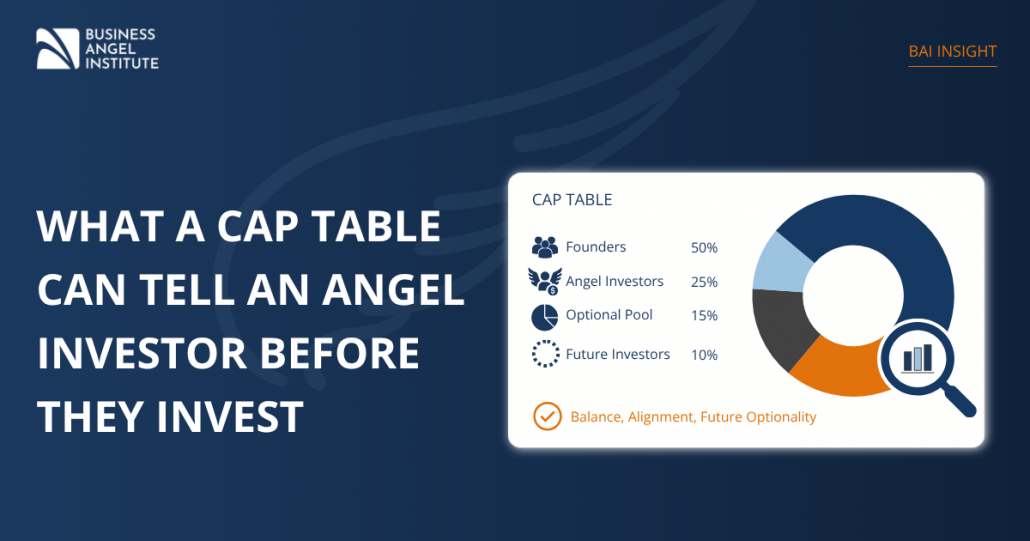
At first glance, a capitalization table can look like a fairly administrative document: names, share classes, numbers and ownership percentages.
For an angel investor, however, a cap table can reveal much more than who owns what. It can offer clues about founder alignment, previous financing decisions, future dilution, employee equity needs and the company’s ability to raise additional capital without creating problems for existing shareholders.
That does not mean one ownership percentage automatically makes a company investable — or uninvestable. Context matters. But understanding how the current structure came to exist, and what could happen to it in future financing rounds, should form part of an investor’s assessment before capital is committed.
Founder ownership tells only part of the story
Founder ownership naturally attracts attention. Investors want the people building the company to remain economically aligned with its long-term success.
But there is no universally “correct” percentage. A founder may have been diluted through previous rounds, brought in co-founders, created an employee option pool or used equity to attract senior talent. Each of those decisions can have perfectly reasonable explanations.
The more useful question is not simply “How much do the founders own?” but “Why does the ownership structure look the way it does today?”

Today’s ownership structure affects tomorrow’s financing
An investment rarely freezes a company’s ownership structure in time. Early-stage businesses may need further financing, additional employee options or new instruments before they reach scale or an exit.
Every issuance of new shares can affect the percentage owned by founders, employees and existing investors. The NVCA defines dilution as the reduction in an existing shareholder’s ownership percentage caused by new share issuance — including follow-on investments and increases in employee option pools.
For an angel investor, that makes the current cap table a starting point rather than an endpoint. The question is not only what your ownership could be immediately after investing, but how the structure may evolve as the company continues to finance its growth.
The Angel Capital Association describes constructing a summary cap table as part of the regular diligence process used by experienced angels. Its guidance highlights founder ownership, option pools, valuation, subsequent financing rounds and potential exit returns as questions a cap table can help investors assess.
Source: Angel Capital Association, Capitalization Tables Demystified. View source
What should an angel investor look for?
A cap table can become highly complex, particularly once different share classes, convertibles, preferences, warrants or several financing rounds enter the picture. But even before detailed modelling begins, a few questions can help investors understand where a closer look may be required.
None of these questions should be interpreted in isolation. A complex cap table is not automatically a bad cap table, just as a simple one is not automatically a good one.
What matters is understanding the economic consequences of the structure — and how those consequences may change under different financing and exit scenarios.
The numbers are only the beginning
This is where cap-table analysis moves beyond simply reading percentages.
A professional investor needs to understand how valuation, option pools, dilution, follow-on rights, different securities and future financing decisions can interact. The Angel Capital Association’s 2025 advanced cap-table training makes the same point: cap-table construction can affect potential returns from both current and future rounds, particularly once terms such as liquidation preferences, anti-dilution provisions, convertibles and employee option pools are considered.
The objective is not to find one perfect ownership structure. It is to understand what the existing structure means, which assumptions sit behind it and what could happen next.
Knowing which signals deserve attention is only the first step. Understanding how dilution, valuation, follow-on investment and deal terms interact requires a broader investment framework.
The CBA™ Certified Business Angel Program covers the investment lifecycle from screening and due diligence to valuation, dilution, additional capital, negotiation, deal structuring, later financing rounds and exits.
If you want to move beyond reading ownership percentages and develop a more structured understanding of what they can mean for an investment, explore the CBA™ Program.

