
Some startups are remarkably easy to like. A strong founding team. A compelling product. An attractive market. Impressive growth. Maybe even a polished pitch that makes the opportunity feel immediately convincing.
All of these things matter. But for an angel investor, they answer only part of the question.
A strong company can still represent an unattractive investment if the valuation, ownership structure, financing requirements, deal terms or potential return do not make sense for the investor.
That distinction is one of the most important shifts from simply evaluating startups to thinking like an investor.
A great company and a great investment are not the same thing
When founders pitch, the focus is naturally on the company: Is the team capable? Does the product solve a real problem? Is the market large enough? Can the company grow?
Investors need to understand all of this. But they also need to look at the opportunity from another angle.
Imagine two investors who are equally convinced that a company has significant potential. One enters at an attractive valuation and receives a meaningful ownership position. The other invests later, at a substantially higher valuation and on different terms.
They are investing in the same company. But they are not necessarily making the same quality of investment.
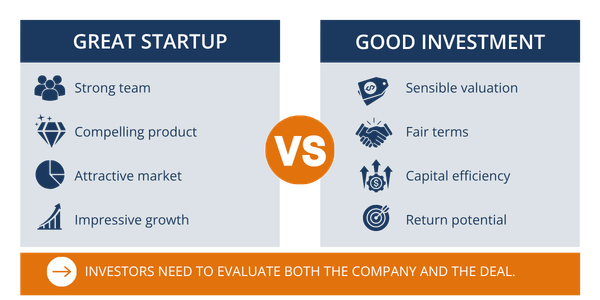
The price at which you enter matters. The ownership you receive matters. Future financing matters. The structure of the deal matters.
And ultimately, what matters is not only whether the startup becomes successful, but what that success could mean for your investment.
Why this matters particularly in angel investing
Early-stage investment returns can be highly uneven. A widely cited study by Robert Wiltbank and Warren Boeker analysed 1,137 realised exits reported by 539 angel investors affiliated with angel groups.
of the exits in the study returned less than the capital invested.
Only 7% achieved returns of more than 10× the original investment — yet those exits accounted for 75% of total investment dollar returns in the sample.
Source: Robert Wiltbank & Warren Boeker, Returns to Angel Investors in Groups, 2007. View the study
The research is historical and focused on group-affiliated North American angel investors, so these figures should not be treated as a prediction of today’s market. What they illustrate very clearly, however, is how dramatically individual early-stage investment outcomes can differ.
That makes it dangerous to reduce an investment decision to whether you believe a startup is “good”. The better question is whether the specific opportunity offers an attractive relationship between potential upside, ownership, risk and the capital required.
Five questions behind the investment
Before turning conviction about a startup into an investment decision, investors should be able to look beyond enthusiasm for the company and consider a second layer of questions.
These questions are deliberately simple. Answering them properly is not.
That is where investment methodology, experience and structured analysis begin to matter.
Experience matters. Process adds clarity.
Angel investing will always involve judgement. At the earliest stages, information is incomplete. Forecasts are uncertain. Markets change. Teams evolve. There is no model that can remove that uncertainty entirely.
But there is a difference between accepting uncertainty and making decisions without structure.
Experience can help investors recognise patterns and ask better questions. A structured investment process helps ensure that those questions are considered consistently — particularly when a founder, product or market creates a very strong first impression.
The objective is not to eliminate intuition. It is to make sure intuition is challenged by analysis rather than substituted for it.
Professional angel investing therefore involves much more than finding exciting startups. It requires the ability to distinguish between a company you would like to see succeed and an investment you are prepared to make.
Knowing which questions matter is a good starting point. Knowing how to evaluate the answers is where professional investment practice begins.
The CBA™ Certified Business Angel Program is designed to build that broader investment framework. It covers the investment lifecycle from strategy, screening and due diligence to valuation, deal structuring, portfolio management, follow-on rounds and exits.
If you want to move beyond simply identifying promising startups and develop a more structured approach to evaluating investment opportunities, take a closer look at the program.
