
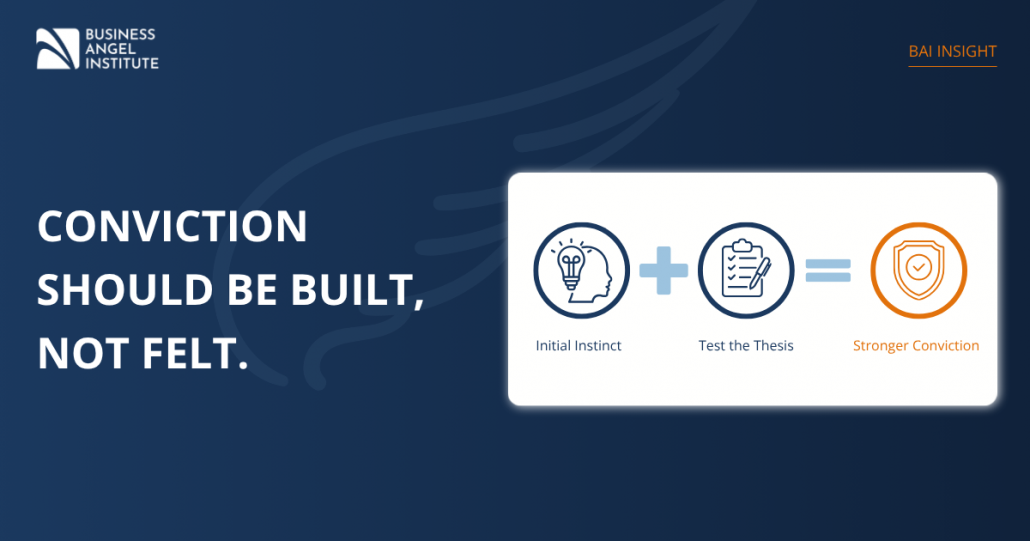
Sometimes an investment opportunity feels convincing almost immediately.
The founder is impressive. The problem makes sense. The market seems ready. Perhaps you know the industry well and recognise patterns from companies or situations you have seen before.
That first reaction can be valuable. But there is an important difference between having an investment instinct and having an investment thesis strong enough to commit capital.
What does investment conviction mean in angel investing?
For an angel investor, investment conviction is a reasoned belief that an opportunity is worth the risk and capital involved. It comes from testing the investment thesis, examining the evidence behind it and deciding which remaining uncertainties are acceptable.
That is different from certainty. Early-stage investing rarely offers certainty. Information is incomplete, forecasts are fragile, markets move and companies can change considerably between the first investment and an eventual exit.
Nor does conviction require investors to ignore intuition. The more useful distinction is between intuition as a starting point and intuition as a final answer.
Why intuition matters in early-stage investing
Angel investors often make decisions at a stage where traditional investment analysis has obvious limitations. There may be little historical financial data. The market may still be emerging. Customer behaviour may not yet be clear. Even the business model itself may change before the company reaches scale.
In that environment, experience and judgement matter.
Research by Laura Huang and Jone Pearce found that angel investors combine formal analysis with what the researchers describe as expertise-based intuition. In other words, experienced judgement can contain useful information when investors are assessing opportunities for which objective data remain limited.
The same broad pattern appears in other markets. Research involving UK business angels has documented the use of heuristics and learning from previous investment experience. More recently, a German study found that 70% of the business angels surveyed reported often making gut decisions when first meeting a company’s management team.
Huang & Pearce, Managing the Unknowable: The Effectiveness of Early-stage Investor Gut Feel in Entrepreneurial Investment Decisions, 2015. View the study
Harrison, Mason & Smith, Heuristics, Learning and the Business Angel Investment Decision-Making Process, 2015. View the study
Heiduk & Schreiter, Deciphering Investment Heuristics: Inside the Minds of German Investors, 2026. View the study
None of this means that investors should simply trust their gut. It means that intuition is already part of how many early-stage decisions are made. A strong process gives that first impression something to push against.
Where confidence becomes part of the risk
The difficult part often begins once an investor starts to like an opportunity.
A strong customer reference looks encouraging. So does a positive market forecast. Another respected investor showing interest can add confidence. A founder who handles difficult questions well may reinforce the impression further.
All of those signals may be genuinely positive. The danger is more subtle: at some point, are you still testing the investment thesis, or are you mostly finding new reasons to support a decision you already want to make?
of the venture capitalists included in one experimental study showed confidence levels above their actual decision accuracy.
The researchers also found that greater overconfidence was associated with lower decision accuracy.
Source: Zacharakis & Shepherd, The Nature of Information and Overconfidence on Venture Capitalists’ Decision Making, 2001. View the study
The study looked at venture capitalists rather than business angels and should not be treated as an estimate of overconfidence among today’s angel investors. But the underlying lesson is useful: professional investment experience does not make someone immune to cognitive bias.
How can angel investors build stronger investment conviction?
A useful investment process should not only help you find reasons to invest. It should also make it easier to discover why you might be wrong.
If the thesis still holds after that challenge, the resulting conviction is much more meaningful.
Confidence and conviction are not the same thing
Confidence describes how strongly you feel about a decision. Conviction should describe how well the investment case holds together.
An investor can be extremely confident about an opportunity built on weak assumptions. Another can remain very aware of the risks and still have a carefully researched, coherent investment thesis.
The second position is not weaker conviction. In many cases, it reflects better investment discipline.
Professional angel investing does not require uncertainty to disappear. It requires the investor to understand which uncertainty remains, why it is acceptable and whether the potential upside justifies taking the risk.
Experience should improve the questions
Experienced angels often become faster at spotting patterns. They may recognise weaknesses in a business model earlier, notice familiar founder dynamics or know which assumptions deserve immediate scrutiny.
That experience is valuable. But ideally, it improves the questions an investor asks rather than removing the need to ask them.
A structured investment process is not there to replace judgement with a checklist. Its purpose is to give judgement a framework in which it can be tested, documented and refined.
Gut instinct can start an investment thesis. Stronger conviction comes from identifying the assumptions behind it, looking deliberately for evidence that could challenge it and deciding which uncertainties you are prepared to accept.
That process will not make every investment successful. Nothing can. But it can make the reasoning behind the investment considerably stronger.
Recognising an attractive opportunity is only one part of professional angel investing. Building a defensible investment thesis requires a broader framework for screening, due diligence, valuation, deal analysis and portfolio decisions.
The CBA™ Certified Business Angel Program is designed to develop that structured investment approach while recognising that early-stage investing will always involve judgement and uncertainty.
