
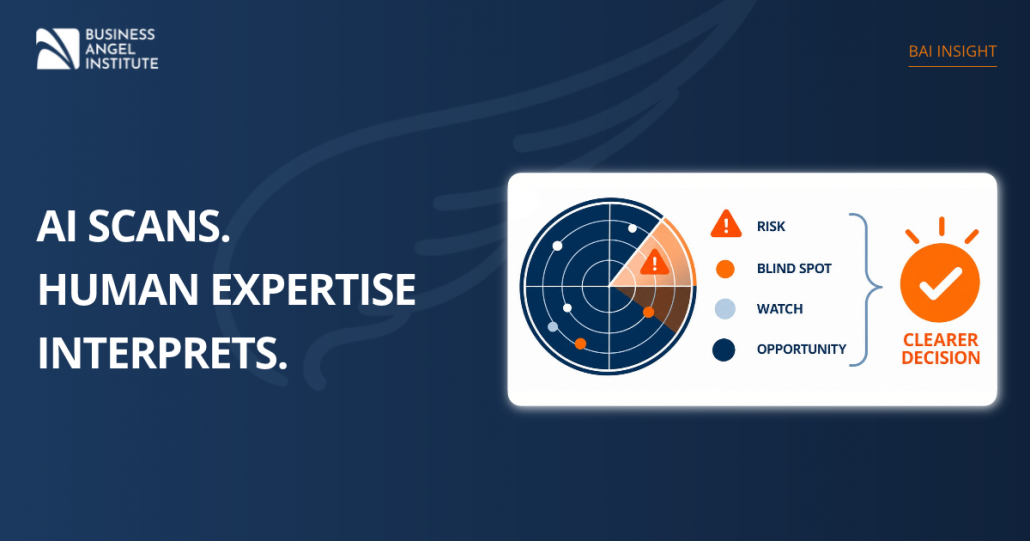
Due diligence has always been one of the most demanding parts of angel investing. Investors need to understand a market, assess a team, challenge assumptions and identify risks – often with limited information and limited time.
Artificial intelligence is changing that equation. AI-assisted due diligence can analyse documents, map competitors, test assumptions and generate financial scenarios within minutes. That gives angel investors access to far more information, far faster – but it does not remove the need for investment knowledge and judgement.
How is AI changing due diligence for angel investors?
The use of AI in professional investment processes is no longer theoretical. Alvarez & Marsal’s 2026 European Due Diligence Report found that more than 80% of surveyed private equity professionals were either consistently using or experimenting with AI across due diligence workstreams. McKinsey reports a similar development across private markets, where AI is increasingly used in sourcing, due diligence and portfolio monitoring.
These studies focus mainly on institutional investors rather than individual business angels. But the direction matters. Analytical capabilities that once required teams of analysts, specialist databases and considerable time are becoming increasingly accessible to individual investors.
Alvarez & Marsal, European Due Diligence Report 2026.
View the report
McKinsey & Company, Global Private Markets Report.
View the report
Why faster AI analysis does not automatically mean better due diligence
Generative AI can produce analysis that looks highly professional even when the underlying reasoning is weak. A market size may combine incompatible sources. A competitor may be classified incorrectly. A benchmark may come from companies at a completely different stage. A calculation can be mathematically correct while the assumptions behind it are commercially unrealistic.
This creates a particular challenge for less experienced angel investors. If you do not understand startup valuation, it is difficult to recognise a questionable valuation analysis. If you do not understand a cap table, you may miss the consequences of dilution or preference rights. If you do not understand unit economics, a confidently presented CAC-to-LTV ratio can appear meaningful even when the assumptions make it almost useless.
Good AI-assisted due diligence still depends on judgement
AI should not simply be used to automate a traditional due diligence checklist. A checklist can ask whether a startup has paying customers. Good due diligence asks why those customers bought, whether they would buy again and what evidence suggests that the next 100 customers will behave like the first ten.
The same applies to technology, markets and financial assumptions. AI can help investigate these questions, but the investor still needs to know which questions matter and which findings could fundamentally change the investment case.
AI can also make confirmation bias more efficient. Ask a system to find evidence supporting an attractive investment opportunity and it probably will. Ask instead: “Assume that my investment thesis is wrong. What evidence would invalidate it?” and the result may look very different.
That may be one of the most useful applications of AI in angel investing: not as a machine that produces reassurance, but as a tool for structured contradiction.
1. What assumptions is this conclusion based on?
A precise answer built on a weak assumption is still a weak answer.
2. Where does the information come from?
AI can synthesise information impressively. That does not automatically make the sources reliable.
3. Would I recognise if the analysis were wrong?
If not, additional expertise or independent verification may be required.
4. Have I asked AI to challenge my thesis?
Search deliberately for contradictory evidence, not only support.
5. What still requires human judgement?
Assessing materiality, weighing conflicting evidence and deciding which risks are acceptable remain investment decisions.
AI is also changing what angel investors need to assess
AI is not only changing how investors conduct due diligence. It is also changing the companies they evaluate. Investors increasingly need to ask whether AI could alter a company’s cost structure, make parts of the product easier to replicate, strengthen an existing competitive advantage or undermine the need for the product altogether.
Why investment knowledge becomes more valuable in the AI era
There is an understandable assumption that increasingly capable AI will reduce the need to learn the technical aspects of angel investing. The opposite may be true. As information becomes easier to obtain and analysis easier to generate, the investor’s ability to ask the right questions, recognise weak assumptions and place information in context becomes more important.
You may no longer need to build every financial scenario yourself, but you still need to know whether it makes economic sense. You may no longer need to research every competitor manually, but you still need to recognise whether the comparison is relevant. AI can accelerate the work. It cannot replace the knowledge required to interpret it.
The faster AI can produce an answer, the more important it becomes that the investor understands enough to question the assumptions behind it.
The future of due diligence will almost certainly be AI-assisted. That is good news for angel investors. But better tools do not automatically produce better decisions. The objective is not to choose between human judgement and artificial intelligence, but to combine the analytical power of AI with investors who understand what they are looking at.
Frequently asked questions about AI and due diligence
Can AI replace due diligence?
No. AI can accelerate research, document review, market analysis and scenario testing, but investors still need to assess the quality, relevance and materiality of the information.
How can angel investors use AI in due diligence?
AI can support competitor research, market analysis, financial modelling, document review, risk identification and thesis testing. It is most useful when investors use it to challenge assumptions rather than simply confirm them.
What are the risks of AI-assisted due diligence?
Key risks include incorrect or outdated information, weak sources, false precision, hidden assumptions, confirmation bias and overconfidence in professionally presented outputs.
Why is investment education still important when using AI?
Because investors need enough knowledge to recognise when an AI-generated conclusion is plausible, misleading or wrong. AI can generate analysis; investment knowledge is required to interpret it.
The CBA™ Certified Business Angel Program develops the structured investment knowledge investors need to evaluate opportunities, challenge assumptions and use AI-assisted due diligence tools critically and effectively.
